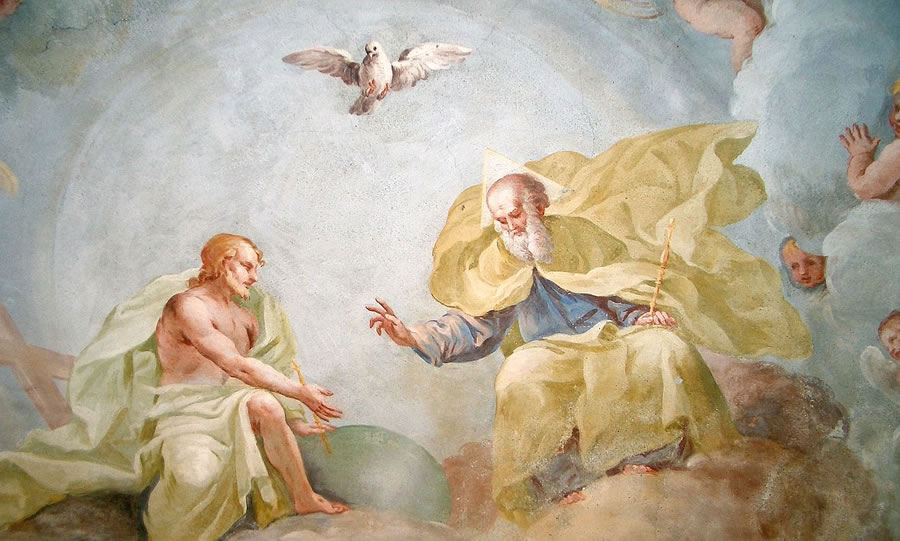
God,the Blessed Trinity, Desires Our Friendship
05-10-2026Weekly ReflectionFr. Leonard F. VillaIn Rublev’s icon painting he depicts the three heavenly visitors to Abraham, reported in Genesis chapter 18, sitting at a table with a cup placed before them on the table. Rublev depicts the three as One Lord. Each holds a rod in his left hand, symbolizing their equality. Each wears a blue cloak, the color of divinity. And each face is the same, depicting their oneness.
- Jesus refers to a very different kind of presence: his presence in the people who love him, in each person who is in a state of grace. “If a man loves me, he will keep my word, and my Father will love him, and we will come to him and make our home with him.” John 14:23 This is the presence of the Blessed Trinity in the soul which has been reborn through grace.
- This is a fundamental teaching of the Christian life frequently repeated by St Paul: “For we are the temple of the living God.” 2 Cor 6:16 he says this to the first Christians of Corinth. Baptism begins our life and relationship with God, Father, Son, and Holy Spirit through sanctifying grace, through which we share the very life of God and is the beginning of Heaven, which is essentially union with God.
- We should learn to become better friends of God who is dwelling within us. Through this divine presence, our soul becomes a miniature heaven. Reflection on that thought can help us enormously. At Baptism the three Persons of the most Blessed Trinity came into our soul: they want to be closer to us throughout our lives than the closest of friends. This presence – which is quite unique – is lost only through mortal sin. (Mortal sin is committed when there is serious matter, AND full knowledge AND full consent. Sexuality is always serious matter.)
- At times we think that God is far away, whereas in fact he is very close to us. He is more interested in what we do than the best of friends. But to talk to God, really present in our soul in grace, we need to control our senses, as they tend to scatter and become attached to all sorts of things. We need to be aware that we are temples of God and to behave accordingly. We need to surround with love, with resounding silence, that intimate presence of the Blessed Trinity in our soul.
- The presence of the three divine Persons in our souls in grace is a living presence, which is open to our friendship: they are inviting us to get to know them and to love them. It is up to us to correspond. We keep our senses for God by means of ongoing mortification throughout the day; that’s also the way to interior contentment. We mortify our imagination by putting aside useless thoughts; our memory, by not entertaining memories which don’t bring us closer to God; our will, by fulfilling our timetable of work and our duties, however small they may be.
- Our heart then needs to distinguish and adore each one of the divine Persons. The soul is, as it were, making a discovery in interior life, like an infant opening his eyes to the world about him. The Holy Spirit is present in the soul of the Christian in grace to make him increasingly like Christ, to urge him to fulfil the will of God and to help him in that task. The Holy Spirit comes as a remedy to our weaknesses, and intercedes before the Father on our behalf, with groans beyond all utterance.
- Let us ask our Lady to help us appreciate this most blessed reality, because our life will then be very different. Why should we feel alone when the Holy Spirit is with us? Why should we ever feel anxious or insecure, even for a single day of our lives, when the Holy Spirit is so attentive to us and to everything we do? See Fernandez, Francis. In Conversation with God, Volume 2, Lent and Eastertide, Monday of the Fifth Week after Easter.
Too Much Talk About Sexual Morality?
It was reported in the Catholic Herald UK that the Pope said: “We tend to think that when the Church is talking about morality, that the only issue of morality is sexual. And in reality, I believe there are much greater, more important issues, such as justice, equality, freedom of men and women, freedom of religion, that would all take priority before that particular issue.” These remarks were made in the context of rejecting the idea that homosexual couples should receive formalized blessings from the Church. The Pope pointed out, perhaps significantly, that general blessings at the end of Mass are intended for everyone. Perhaps the Pope was referring to something that was often said about the Church in the past but is certainly not true now. The Catholic Herald article acknowledges this:
Yet over-emphasis on sexual ethics is scarcely the major problem of our current time. For it is precisely the removal of sex from its proper context, and the treatment of sexual pleasure as an unalloyed good to which we have a ‘right’, which is distorting morality and therefore ourselves in fundamental ways. To separate sex from marital and family community and to treat it as though it could be an end in itself is to deny sexual acts their moral weight, implied precisely by their connection with those fundamental goods. If we act in this way we are engaged in extreme denials of community, and most especially the family, without which we cannot truly appreciate what the common good might be.
We live in a fornication/adultery culture often celebrated and/or taken for granted in the popular culture. In so many situations in movies, TV, and books it is taken for granted that if you are dating sex is part of the understanding, that there is nothing wrong with this. The only issue is to use contraceptives. So, the idea that sex outside of marriage — not to mention adultery — is by its very nature seriously harmful to the human being is like speaking a foreign language. There is a serious lack of preaching about the harm of sexual sins to the human person. There is also false reasoning: that because a person does not see any harm therefore there is none. God tells us to avoid behavior which He knows will hurt us. We need to trust Him.
One of the “children of lust” is blindness — not physical blindness but spiritual blindness as to the harm being caused by lustful behavior. People often enough realize this with pornography; they might see the harm of adultery; but they very often do not see this with having sex while dating, assuming this is okay because everybody is doing this. The harm to the spiritual life with mortal sin is the loss of the Presence of God within the soul. All sexual acts outside of lawful marriage are seriously sinful. Venerable Pius XII reminded the Church and noted:
“[...] It will be objected, however, that such abstinence is impossible, that heroism such as this is not feasible. At the present time you can hear and read of this objection everywhere, even from those who, because of their duty and authority, should be of quite a different mind. [...] We have the doctrine of the Council of Trent which, in the chapter on the necessary and possible observance of the Commandments, referring to a passage in the works of Augustine, teaches: ‘God does not command what is impossible, but when He commands, He commands, He warns you to do what you can and to ask His aid for what is beyond your powers, and He gives His help to make that possible for you.’ [...]”
BACK TO LIST