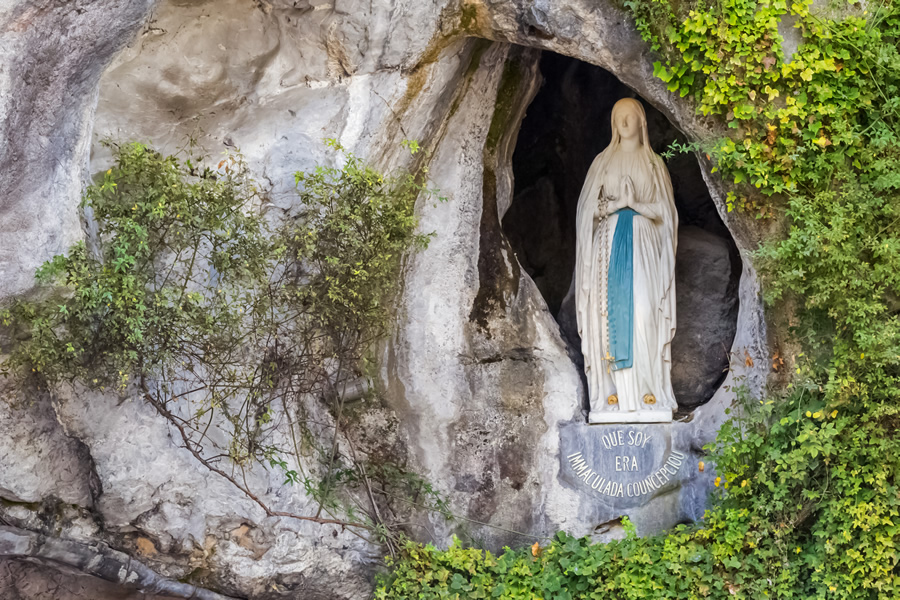
A Miracle at the Lourdes Grotto
08-16-2026Weekly ReflectionFr. Leonard F. VillaDiary of a Cure: A Nobel Prize Winner in Medicine in the face of the miracles of Lourdes
The son of a bourgeois from Lyon, Doctor Alexis Carrel, has lost his faith. Believers are, for him, naive children or stubborn fanatics. He wanted to be a scientist who was absolutely impartial in the face of the facts:
In May 1902, a doctor friend, abruptly prevented from accompanying the sick on a pilgrimage to Lourdes, asked Carrel to take his place.
Carrel hesitates, but after all, why not study these stories of Lourdes as a scholar? If there are only imaginary cures, the loss of time will not be very great! If, by chance, there is a real effect, whatever the cause, it must be studied in a truly scientific way, without bias, as one would study a patient in a hospital, or as if it were a laboratory experiment. "If you discover deceptions or errors, then you have the right to report them. If, by some impossibility, the facts were real, we would have the good fortune to see something infinitely interesting, which could put us on the road to very serious things."
The Journey to Lourdes (May 1902) Carrel is leaving... Of all the sick people on the pilgrimage, Marie Bailly requires the most care; she is dying. "During the night, Carrel had to give the patient injections. He takes the opportunity to study her case: he studies her history, her parents who died of tuberculosis, she herself is always sick and coughing, coughing up blood since the age of 17, and finally tubercular peritonitis. Carrel's notebook notes the progress of the disease.
Wednesday, May 28 That day seemed to be her last: Carrel noted hour by hour what he already called "the bankruptcy of the miracle": 1 hour 15 minutes (afternoon) Very bad condition. The patient answers with difficulty and in a vague way the questions are put to her. Very painful. Pulse irregular, small, almost incalculable at 160; jerky breathing at 90, face seized, very pale, slightly purplish. The nose, the ears, the extremities have cooled down. At this moment Dr. Geoffray, from Rive-de-Gier, arrived, he looked at the patient, probed, listened to the heart and lungs; he told us that she was in agony. As there is nothing left to lose and the patient wants to go to the grotto again, she is carried there on a stretcher.
1 hour 50 minutes Arrival of the patient at the pools. She is inert, lying on her back, her face turned back, discolored, with a purplish tint on her cheekbones, breathing very rapidly; under the blanket you can see the protrusion of the belly.
2 hours 20 minutes on leaving the pools, she is carried in front of the grotto; the stretcher is placed on the ground; few people yet, the religious ceremonies have not begun; the sick woman is in full light; it is easy to examine her. So, under Carrel's eyes, the patient comes back to life.
2:30 p.m. to 2:40 p.m. Breathing slows down and becomes more regular. The appearance of the face changes, a very slight pink tint spreads over the skin of the face. The patient seems to feel better and smiles at her nurse leaning over her. "I'm hallucinating," he said to himself, "it's an interesting psychological phenomenon and one that should perhaps be noted." He took out his pen and noted on his cuff the exact time of his observation. It was forty minutes past two. "However, to this day, I have never had a hallucination," he said to himself. Suddenly he felt himself turn pale.
2 hours 55 minutes the profile of the body visible under the blanket changes and the protrusion of the belly drops, the improvement in the general appearance becomes noticeable and obvious.
3 hours 10 minutes the hands, ears, nose are warm. Breathing slowed down, 40 per minute, the heart stronger, more regular, but fast at 140. The patient tells us that she feels better; she is made to take a little milk; there is no more vomiting.
3 hours 20 minutes the patient rises and looks around her. In place of the belly, the blanket has become depressed. The legs move and the body turns to the right side. The face became calm and pink.
3 hours 45 minutes the stretcher is carried to the Rosary.
4:15 a.m. the improvement has been accentuated. The breathing is calm, the face rosy. The patient tells me that she feels very well and that, if she dared, she could get up. Its appearance changes so much that everyone notices. It is then taken to the Bureau des Constatations. She arrives lying on a mattress. She leaves sitting in a small car. The doctors' declarations are entered into the registers.
The minutes reproduce exactly the impressions of our colleagues. 7:30 p.m. Examination at the hospital. Excellent general appearance, very emaciated face, calm and rosy, very regular breathing. The belly now has the supple, elastic and depressed wall of a well-constituted and very emaciated twenty-year-old girl. This extremely thin wall allows a very easy exploration of the organs; the aorta beats under the finger; on the right side, in the depth, a hard mass, which occupies the flank and rises in the lower back. Between the two hands a very hard cake, not painful, as big as the forearm, is circumscribed, firmly fixed against the posterior wall of the abdomen. This tumor does not move during breathing movements.
8 p.m. Continuous improvement; louder voice, breathing 30; pulse 100, regular and full. Carrel feels like he's been punched on the head by turning the problem around in all directions. "This young girl is completely healed, that's indisputable... It is the realization of the impossible. He verifies the diagnosis: he was not mistaken. He continued to examine Marie Bailly back in Lyon."
Wednesday, June 4 Marie Bailly has the appearance of a healthy young girl; good appetite, rapid increase in weight, nearly a pound. Absolutely supple belly, disappearance of all tumors. No stigma of hysteria, no reduction in the visual field, no intellectual disorders. In the course of her illness, moreover, no symptoms of hysteria had been found in her, no nervous crises, no depression, no excitement, and a gentle and calm character.
June 27 Since then, increase of 6 kilos, perfect health. During the second week of July, there is no more swelling in the legs. The patient is completely cured. Her weight increased by one kilogram per week. Overall perfect condition. This young girl is modest, calm, quite intelligent, with a very clear memory, speaks of her recovery only when questioned, does not play the saint.
August 8 Left the hospital, was accepted as a novice by the Sisters of Saint-Vincent-de-Paul. In search of explanation the day before the recovery, Carrel had talked with an old schoolmate he had met by chance. Reviewing the patients likely to recover, Carrel had reported a few cases. Speaking of Marie Bailly, he said: "If she were cured, it would really be a miracle."
At the same time as he constructs all the possible hypotheses to escape the confession of the miracle, he feels stuck: "Either clinical certainty no longer exists for me and I am unable to study a patient, or else here is a new fact, truly astounding, which must be studied in its smallest details." It was very unpleasant to him to be mixed up in a story of a miracle, but he had come to see what he had seen, and as in a laboratory experiment, he could not distort the result of his observations. New scientific facts? Or facts belonging to the realm of the supernatural? These questions were of considerable gravity; for it was not a question of a simple adherence to a theorem of geometry, but to things that can change the direction of life. Carrel wants to believe, "to believe desperately, blindly, without ever discussing or criticizing again." But in fact, he can't do it. He invokes the Virgin: "Gentle Virgin, helpful to the unfortunate who humbly implore you, keep me [...] You wanted to answer my doubt with a brilliant miracle. I don't know how to see it and I still have my doubts."
Carrel has not yet been able to say: God. But he remains loyal to the facts. In Lyon, the recovery of Marie Bailly is getting out. During dinner, a professor from the Faculty of Lyon questioned him. Carrel affirms the facts. An icy cold seized the group: the Faculty of Lyon was then materialistic and did not like the miraculous. "Oh, I can't explain myself," Carrel continues, "in the general silence, I don't argue. I only report the facts. That's all. "There is no need to insist any further," replied the professor. With such ideas I think I can tell you the Faculty of Lyon will not open its doors to you."
Thus, two years later, Carrel embarked for America where his work on organ transplantation earned him, in less than eight years, the Nobel Prize in Medicine (1912). Always a rationalist, Dr. Carrel remained in doubt. But the extraordinary healing carried out before his eyes, in Lourdes, pursued him. In 1938, 35 years after the trip to Lourdes, he wrote: "In the depths of darkness there is still the hope of light. But light cannot come from intelligence."
Indeed, human intelligence needs divine help—grace—to attain the truth about God. In May 1944, a few months before his death, he wrote: "This God, so accessible to those who know how to love, hides from those who only know how to understand." He insists on the importance of prayer: "Just as breathing is the function that allows gaseous exchanges between our body and the atmosphere, so prayer would be the function that allows exchanges between God and man."
Finally, Dr. Carrel died in peace, fully Catholic, equipped with the Last Rites (confession, communion, extreme unction) on November 5, 1944. It took him all his life to find his faith, and he had previously defended some adventurous ideas. But the Virgin Mary answered his prayer. She led him to God.
He wrote, shortly before his death: "For every man, death has different meanings; for death depends on life; and the meaning of life changes according to the individual. Almost always death is like the end of a monotonous, painful, sad rainy day. Sometimes it has the beauty of twilight in the mountains, or it resembles the hero's sleep after the fight. But it can be, if we will, the immersion of the soul in the splendor of God. Six years earlier, on November 3, 1938, he had noted in his diary: "Lord, my life has been a desert, for I have not known you. Let the desert flourish despite autumn! May every minute of the days that remain to me be devoted to you."
BACK TO LIST