The Origin of the Statue of the Holy Infant of Prague
09-06-2026Weekly ReflectionLet us pray to the Holy Infant of Prague.
It was once very popular to give a statue of the Infant of Prague surrounding weddings, new homes, and for special intentions. There is a statue of the Infant of Prague in our parish church. How did devotion to the Infant Jesus of Prague originate? In 16th-century Spain, devotion to the royalty of the Infant Jesus began to spread. Out of great love for the humanity of Christ, St. Teresa of Avila developed the Carmelite devotion to the Infant Jesus.
Whenever she founded a monastery, she not only wanted a statuette of the Infant Jesus to be venerated, but also that this statuette had different poses and robes. From the Carmelite convents of Spain, the devotion spread to all the Carmelite convents of Europe.
The story of what would later become the miraculous Infant Jesus of Prague begins in 1628. The then prior of the Discalced Carmelite convent in the Bohemian city, Father John Louis of the Assumption, concerned about the extreme poverty of the house, had an inspiration: he instructed his brothers to search for a statue of the Infant Jesus to entrust the convent's fortunes to him. The statue was donated by Princess Polissena of Lobkowicz, who had already distinguished herself as a benefactor of the Carmelites in Prague. It depicted a beautiful Infant Jesus in regal robes, standing (thus in that new position that had begun to spread in 16th-century Spain), with the world in his left hand and his right in a blessing gesture. By order of the Prior, it was brought to the novitiate and placed on the altar of the oratory.
The Discalced Carmelites arrived in Prague after the famous Catholic victory at the Battle of White Mountain (November 8, 1620). It was the so-called Thirty Years' War, and the Catholic army, loyal to the Emperor, had defeated the rebel army, loyal to the Protestant Calvinist Prince-Elector of the Palatinate, Frederick V. Following that victory, attributed to the help of the Virgin Mary, the Carmelites were called to Prague in 1624 and assigned a church, renamed "Our Lady of Victory."
But in 1631, the Prince-Elector of Saxony began the siege of the city. Many fled, including members of the imperial army. Shortly thereafter, Prague capitulated. Protestant soldiers plundered churches and convents and even imprisoned the few remaining Carmelites. When they saw the statuette of the Infant Jesus King in the oratory, they burst into blasphemous laughter and shouted, "There's the papists' puppet!" One of them, out of contempt, chopped off his hands with a sword and threw him behind the altar. Thus, the Holy Child fell among the ruins of the Church of Our Lady Victorious, where it remained forgotten for a long time among the rubbish. The Peace of Prague, signed in 1634, allowed the Carmelites to return to their convent, by then almost completely destroyed, but no one remembered the statuette anymore.
In 1637, Father Cyril of the Mother of God also returned. The war was not yet over. The Swedes broke the agreement and besieged Prague again. Meanwhile, Father Cyril searched for the statuette and was overjoyed when he finally found it. All the friars in the convent were able to pray fervently to the Child Jesus, and Prague emerged unscathed from the Protestant destruction. One day, while praying before the statue, Father Cyril reported to have heard a voice say, "Have pity on me, and I will have pity on you. Give me my hands, and I will give you peace. The more you honor me, the more I will bless you." The convent, too, after two difficult years in which the blessing of the Holy Child had been missing, once again enjoyed the support of benefactors and a fruitful peace. Since then, devotion to the Infant Jesus of Prague has continued and spread throughout the world.
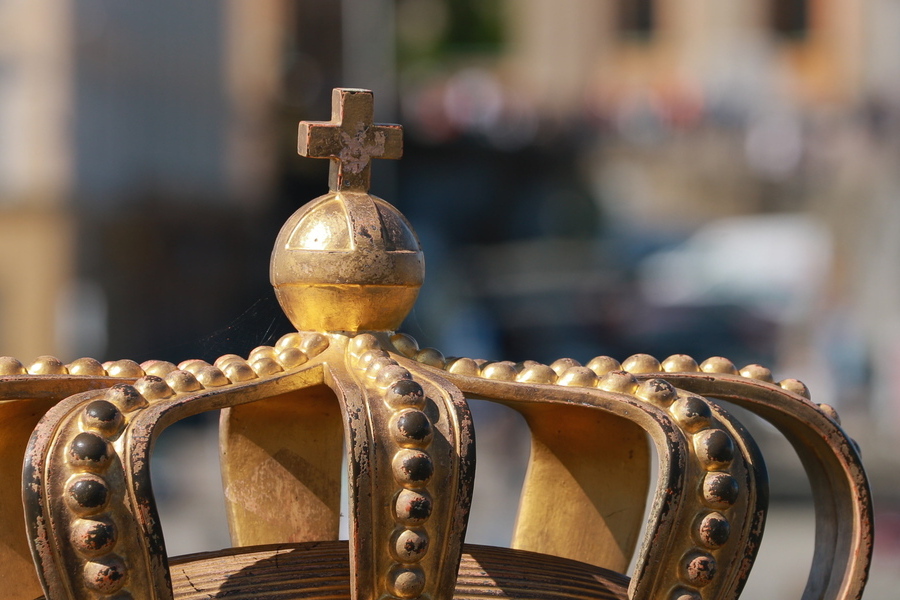
The Statue of the Infant Jesus of Prague: In His left hand, the Infant Jesus holds a miniature globe topped by a cross, representing His kingship over the world. His right hand is raised in blessing, with two fingers bent to reflect Christ's divine and human nature, and the other three fingers raised to symbolize the unity of the Trinity. Until the 16th century, devotion to the Infant Jesus was primarily, or even exclusively, focused on the Infant Jesus in the cradle, at the Nativity. That is, the Infant Jesus of tenderness, weakness, and "smallness." Since this century, however, there has been not only the Infant Jesus lying in the cradle, but also the Infant Jesus as King, with a crown on his head and the world in his hand. Therefore, not only the Infant Jesus in his natural position as an infant (the cradle), but also the Infant Jesus who, as God, is King of the entire universe. It is the belief that Christ's lordship also encompasses tenderness and gentleness, typical traits of childhood.
What are the theological foundations of this devotion? The Kingship of Christ flows from the fact that the Son of God became man, died for our sins, rose from the dead, and opened the gates of Heaven. He is Lord. First consequence: every action (even the most banal) performed by Christ had infinite value. The value of an action, in fact, is determined by the dignity of the subject who performs it. Since the subject of Christ is divine, all his actions had divine, that is, infinite, value. A single tear of Christ had infinite value, as did a single discomfort or suffering. Every event that Jesus lived, he also lived as God the Son. The Incarnation tells us that God the Son experienced all the phases of human life through His humanity.
Devotion to the Infant Jesus of Prague confirms how sovereignty must be experienced as a manifestation of Christ as Lord. In the Christian conception of politics, authority is understood not simply as a manifestation of power, but of service. He, who knows how to sacrifice himself, who is willing to sacrifice himself for his subjects, commands. The leader is he who goes before the armies, who risks the most. The greater the authority, the greater the responsibility. God the Son, by becoming man, truly lives the experience of childhood and who reigns while also preserving his own childhood. He is a God who serves. He is a God who makes himself small to put himself at the service of all. A great lesson for those who exercise political authority!
Devotion to the Infant Jesus of Prague confirms how sovereignty must be experienced as filial abandonment to God. The Christian conception of politics, recognizing authority also as an exercise of obedience to God, affirms that those who command must place their authority in God. Saint Louis IX, the great King of France, was accused of being a "short-necked bigot" because he spent more time praying in chapel than governing his subjects. But he would often respond: “My vocation is charged to me as a crime, but no one would say a word of blame if I spent all that time hunting or gambling." And it is no coincidence that his reign was one of the most illustrious in French history.
BACK TO LIST